Jamieson Greer is the United States Trade Representative. This page tracks publications from this office and sourced personal appearances — 39 source records across 28 days — compiled automatically from the linked source and updated daily.
- Office: United States Trade Representative
- Country: 🇺🇸 United States
- Office base: Washington, D.C. (not current location)
- Latest entry: Friday, October 23, 2026
- Overseas days tracked: 0
- Tracking since: Monday, July 20, 2009
- Source: Office of the U.S. Trade Representative — Press Releases
- Subscribe: 📅 Calendar (iCal) · 🔖 RSS
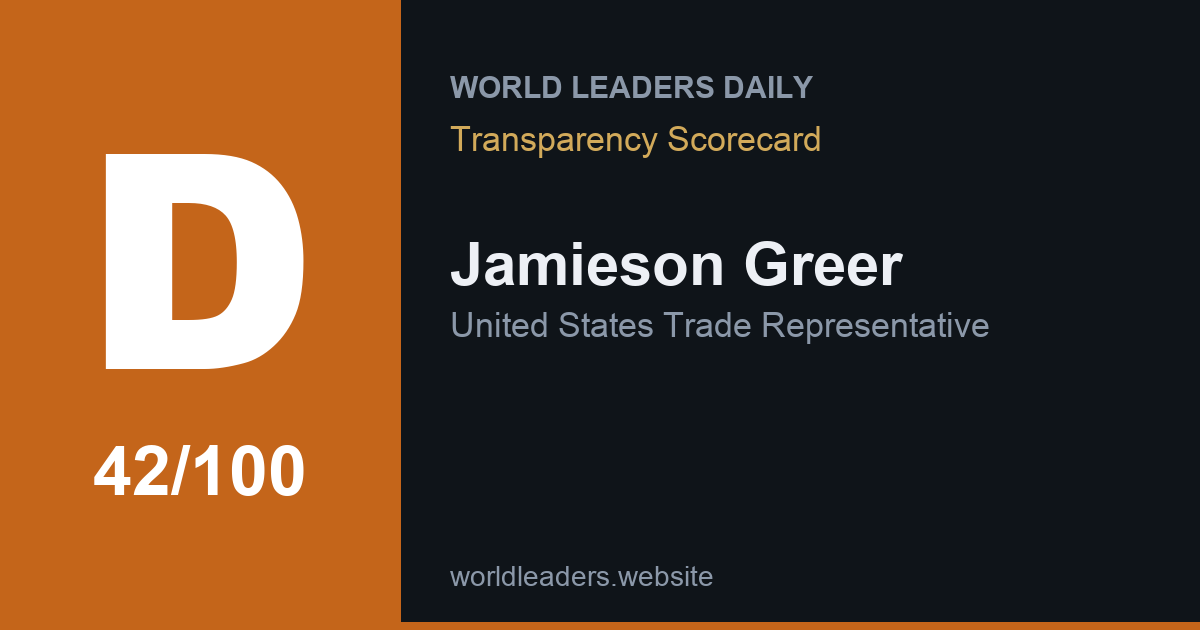
- Publication score: grade C (scorecard) · share card ↗
Greer today
This week’s sourced appearances
No dated appearances are available for 2026-10-25 to 2026-10-31. Check source coverage or inspect the latest office publications below.
Source coverage Fresh source
Publication and occurrence dates are distinct. Source retrieval does not confirm the leader's current location.
- Source type
- Configured office publication; tier unreviewed
- Language
- en
- Last successful retrieval
- Latest source publication
- 2026-10-23T20:06:58+00:00
- Latest attempt
Source attempts
- rss: parsed; no error recorded
Compare source coverage · Suggest a source or correction · Revision log and correction policy
Meetings & interactions with other leaders
- Oct 19, 2026 — Donald J. Trump: Source-reported in person meeting: Ambassador Greer Highlights the Success of President Trump’s Trade Program in Fueling America’s Industrial Resurgence While Touring Utah Plants
Recent office records & appearances
Office publications do not establish personal attendance. Occurrence dates and publication dates are shown separately. Search the full retained archive →
Friday, October 23, 2026
Evidence & corrections
- Record type
- Office publication · unknown
- Attribution
- office_publication
- Occurrence date
- Not established
- Publication date
- 2026-10-23T13:06:37+00:00
- Date evidence
- Source publication timestamp
- Location evidence
- Venue not established
- Review
- Automated extraction; not independently reviewed
- Timezone basis
- unknown · No timezone evidence retained
- Named person
- No named person established; this is an office record
- Tenure attribution
- unknown
Evidence & corrections
- Record type
- Office publication · unknown
- Attribution
- named_person_unverified_tenure
- Occurrence date
- Not established
- Publication date
- 2026-10-23T20:06:58+00:00
- Date evidence
- Source publication timestamp
- Location evidence
- Venue not established
- Review
- Automated extraction; not independently reviewed
- Timezone basis
- unknown · No timezone evidence retained
- Named person
- Jamieson Greer
- Tenure attribution
- unknown
Wednesday, October 21, 2026
Evidence & corrections
- Record type
- Office publication · unknown
- Attribution
- named_person_unverified_tenure
- Occurrence date
- Not established
- Publication date
- 2026-10-21T23:05:13+00:00
- Date evidence
- Source publication timestamp
- Location evidence
- Venue not established
- Review
- Automated extraction; not independently reviewed
- Timezone basis
- unknown · No timezone evidence retained
- Named person
- Jamieson Greer
- Tenure attribution
- unknown
Monday, October 19, 2026
Evidence & corrections
- Record type
- Office publication · unknown
- Attribution
- office_publication
- Occurrence date
- Not established
- Publication date
- 2026-10-19T18:41:24+00:00
- Date evidence
- Source publication timestamp
- Location evidence
- Venue not established
- Review
- Automated extraction; not independently reviewed
- Timezone basis
- unknown · No timezone evidence retained
- Named person
- No named person established; this is an office record
- Tenure attribution
- unknown
Evidence & corrections
- Record type
- In-person meeting · confirmed
- Attribution
- named_person_unverified_tenure
- Occurrence date
- 2026-10-19
- Publication date
- 2026-10-19T20:43:36+00:00
- Date evidence
- Explicit 'today' in source text, anchored to publication date
- Location evidence
- Venue not established
- Review
- Automated extraction; not independently reviewed
- Timezone basis
- unknown · No timezone evidence retained
- Named person
- Jamieson Greer
- Tenure attribution
- unknown
- Supporting evidence
- Ambassador Greer Highlights the Success of President Trump’s Trade Program in Fueling America’s Industrial Resurgence While Touring Utah Plants. Ambassador Greer Highlights the Success of President Trump’s Trade Program in Fueling America’s Industrial Resurgence While Touring Utah Plants myarbrough Mon, 10/19/2026 - 16:43 WASHINGTON – Last week, Ambassador Jamieson Greer met with blue-collar workers and toured advanced manufacturing facilities, spanning from the nation’s largest ski manufacturer to a new semiconductor fabrication plant in development. Back at his alma mater, Ambassador Greer met with students and faculty at Brigham Young University (BYU) to discuss how President Trump’s trade policy is rebalancing global trade to secure lasting benefits for Americans today and the generati
Friday, October 16, 2026
Evidence & corrections
- Record type
- Office publication · unknown
- Attribution
- office_publication
- Occurrence date
- Not established
- Publication date
- 2026-10-16T16:57:10+00:00
- Date evidence
- Source publication timestamp
- Location evidence
- Venue not established
- Review
- Automated extraction; not independently reviewed
- Timezone basis
- unknown · No timezone evidence retained
- Named person
- No named person established; this is an office record
- Tenure attribution
- unknown
- Revision history
- [{"title": "Governments and Faith Communities: Supporting the Economic Fundamentals of “The Good Life”", "time": null, "end_time": null, "summary": "Governments and Faith Communities: Supporting the Economic Fundamentals of “The Good Life” pbrouillette Fri, 10/16/2026 - 12:57 As Prepared for Delivery on October 16, 2026 G20 Interfaith Forum Good morning. Thank you for that generous introduction. I am honored and humbled to address this group and its distinguished attendees. Although I was born and raised in California, my ancestors and many of my extended family have lived in the great Mountain West of the United States, and as a member of the Church of Jesus Christ of Latter-Day Saints I share the faith tradition that was nurtured in the mountains and valleys here in Utah. But my comments today do not represent the Church, nor do they represent the faith-related policies of the Trump Administration. Rather, I am here to talk about economic policies that will lift people up across the globe. Almost all faith traditions believe that God expects us to work. Work is not only a moral imperative; it is also a blessing to individuals, families, and communities. At the same time, heaven is not a counting house where God tallies every nickel and dime and measures our worth by our earthly balance sheets. Our economic activity – individually and in communities – should reflect deeper meaning. In addition, world religions teach us that God expects people of faith to help the poor and the needy, and not to stand in judgment of them. These teachings can sometimes seem to be in tension. But this tension can be resolved. Governments and religious communities can, in fact, help people meet the material needs of this life while also contributing to their spiritual well-being. Today, I want to address two overarching questions: The first question is really a two-parter: (1) what kind of society are we trying to create, and (2) what are the economic policies that can support that society? The second question is: what can faith communities do to support economic policies that are the most likely to achieve the type of society that will benefit the broadest portion of humanity? So I will first discuss, what kind of society do we want? Many of our brightest thinkers have discussed this question, with Aristotle and his successors asking “what is the good life?,” or in the more modern parlance of Joseph Stiglitz, “what is gross domestic product good for?” So a lot of ink has been spilled on this topic, but I think average people know the answer. The Pew Charitable Trust Research Center did a global survey in 2021 asking people across age groups and countries what provides the most meaning in life. The universal answer was family first, generally followed by either an occupation or material well-being [1] . Respondents in the United States and United Kingdom ranked “friends” in the number 2 spot. And you would not be surprised to know that older survey participants rated good health higher than younger participants. So this is the kind of society we want: one where people can form a family and relationships and also have meaningful work that allows them to obtain a home and achieve social and economic mobility. I would say that an unspoken dynamic here as well is that people want all of these things together, meaning they want to be able to live with or by their family and friends as they achieve their economic goals. It’s unsatisfying and challenging to have one without the other. A thriving society like this results in strong community cohesion and a shared sense of purpose. Communities with robust opportunities for work and production are safer than other communities, and they become high-trust societies with low crime and better health and educational outcomes [2] . Importantly, these types of societies value families and children. Policymakers should support economic policies that will promote these outcomes. Economic policies of course can lead to negative outcomes. For example, here in the United States, and in my own line of work, we are attempting to remedy previous international trade policies that had a negative effect on certain populations. For several decades, U.S. companies took advantage of laissez-faire trade policies to move manufacturing and production from the United States to other countries for a variety of reasons. This left many Americans previously employed in factories and plants without jobs in their hometowns. Recent studies by David Autor and co-authors show that these policies resulted in unemployment and underemployment among those that lost their jobs to offshoring. Studies by economists from the University of Chicago and University of Wisconsin showed that the North American Free Trade Agreement resulted in negative health outcomes among workers in the United States where that trade agreement changed the fabric of the local economy [3] . Thus, we have had entire communities where the loss of a factory meant lost income for parents, fewer opportunities for children, and second-order effects of increased drug abuse and premature deaths. In the United States, we are trying to change our policies to avoid these outcomes and promote a society that is fulfilling: one where people can develop relationships with family and friends while meeting their economic needs. To achieve this type of society I believe you also need to ensure national and domestic security, you need good health and education policy, and you need political rights and freedom of religion and expression. I won’t talk about those today, but I will attempt to answer the question of what kind of economy and economic policies can support a thriving and fulfilling society? The global economy and international economic policy should operate to bless society, and not the other way around. Capitalism, market economics, and the protection of intellectual property have led to enormous welfare gains. I take the United States as an example: a long-term commitment to free enterprise has lifted entire generations out of poverty. In 2025, the poverty rate in the United States dropped to 10.2 percent – the lowest since we started tracking these data in 1959. However, economic policy should not prioritize efficiency and profit-maximizing at all costs. There are quantifiable (and non-quantifiable) harms from extreme libertarian economic policies. For example, unregulated concentration of production can limit opportunities for new entrants or harm consumers, workers may suffer from severe power imbalances in the employment relationship, and firms may engage in business practices that disregard economic or national security. On the other hand, certain economic policies notionally designed to correct for excesses of capitalism can actually degrade the well-being of individuals, families, and communities. This may include the seizure of private property, suffocating taxation, and corruption that can arise from government interference in private business. A responsibility of government is to find the right balance among economic policies. Even though we live in an imperfect world, governments can promote economic policies that increase the chances for all to live the good life: Governments must recognize and encourage the worth of individuals and families as producers, and not just as consumers. Governments should enact policies that help people create wealth, as opposed to simply allocating it or consuming it. Most economic activity fundamentally begins with a person taking something out of the earth and making something of it: crops from the soil, fish from the sea, and minerals from the ground below us. From these resources, we forge tools and machinery, we process food and drink, and we create chemicals and engineer solutions that prolong life and bring convenience. In short, we generate wealth that can translate into well-being. But in many developed countries, a rush towards financialization and speculation has reduced our focus on manufacturing, agriculture, and the associated services. This trend has turned many of our brightest students to financial wizardry, high-risk derivatives, and unstable Ponzi schemes or multi-level marketing scams. And as some societies shifted away from production, people also began to feel less like participants in the system and more like victims of it. Instead of generating wealth, the United States and other countries have focused on attempting to print wealth and allocate it around the economy, with middlemen taking their share off the top with each new financial instrument. Obviously, there is a strong need for reliable financial services to help guide capital to its most efficient use, but this must stand on the foundation of the creation of capital in the first place. In Judaism, the concept of Yishuv ha-olam (yee-SHOOV hah-oh-LAHM) emphasizes that we are to settle or help establish a sustainable world. We are to be stewards of the world we have been given, and not only receivers. In the Book of Genesis (2:15), Adam is placed in Eden “to work it and guard it.” From our earliest days, we were meant to be producers through our labor, not just consumers. As we read in the Book of Exodus, in the Ten Commandments, Moses received instructions for the children of Israel: “Six days shalt thou labor and do all thy work.” We tend to focus on this commandment in relation to the Sabbath – a day of rest—but it of course expects that the other days we will work in a productive capacity. In addition to prioritizing domestic production first and consumption second, government should provide for fair trade and commercial opportunities. Trade or commerce on its own is not necessarily good or bad: it just is. The more important question is not just whether enterprise is “free,” but whether it is “fair.” We have all kinds of policies that address unfairness: antitrust laws, employment and labor laws, anti-corruption efforts, and international trade laws. They all tend to deal with vast imbalances of economic or other power that can endanger fairness and limit opportunity. By making thoughtful corrections where market forces do not prioritize the type of outcomes our countries need, policymakers can promote societies where individuals and families can thrive. And so, after all of that, the remaining question is how can faith communities and leaders support economic policies that help us move toward our desired society? Some religious communities have promoted economic policies that attempt to find the right balance. In the United States, we have had faith traditions that promote a political economy based on community cohesion and support. The Transcendentalists of the 19th century sought to live simply and produce only what was need for consumption. The United Order of the Church of Jesus Christ of Latter-Day Saints sought to have its participants donate all their material possessions and earnings to the Church for an ecclesiastical redistribution. Your countries may have had religious groups make similar efforts. These initiatives have not always been successful, largely due to the imperfection of humanity or structural flaws. But these traditions do have a few common themes that are instructive, chief among them is that all should contribute to the community economy as producers first and as consumers second. This is a blessing as individuals become contributing participants in the economy and not victims of it. President Dallin H. Oaks of the Church of Jesus Christ of Latter-Day Saints recently observed the relationship between family life and making a productive contribution to society. In October 2025, he warned that “[p]arental influences have … been diluted by the way in which [many people] earn a living. In times past, one of the great influences that unified families was the experience of struggling together in pursuit of a common goal—such as taming the wilderness or earning a living. The family was an organized and conducted unit of economic production . Today, most families are units of economic consumption , which do not require a high degree of family organization and cooperation.” As faith communities support families, and support families working together, they will support economic policies that have a broader beneficial effect on society. Faith communities can also create a fulfilling economy by promoting self-reliance. Contributions to workforce initiatives, training programs, and welfare-to-work programs can answer God’s call to help the needy while also dignifying them as producers and participants in the economy. Leading people to become self-reliant can succor the immediate needs of those in distress while providing them a long-term pathway to partaking in the good life that we all seek. Religious communities should also support the rule of law by encouraging their members to be civically active and responsible. This may seem unrelated to economics, but a fair and just legal system helps create trust that the economic system will be fair and equitable. Without this bedrock, it can be difficult for members of a society to believe that they will benefit from the economy, and they may worry that the system is “rigged,” as some say. Finally, it is critical that faith communities discourage harmful economic behavior, both at the institutional and individual levels. Practices such as financial speculation and highly-leveraged, high-risk economic activities can put entire swathes of an economy in trouble. Religious communities should also highlight and fight human rights violations that create perverse economic incentives, such as the scourge of forced labor, and they should fight corruption and dishonesty in all its forms. Religious communities should also combat vice that harms the family economy. This can include addictive gambling, which can bankrupt individuals and families with the illusion of generating wealth. Faith communities should also encourage their members to live within their means, taking a lesson from Joseph in Egypt who warned Pharaoh to put up seven years of storage to prepare for the eventual famine. As people—or countries—turn to credit to support extravagant lifestyles, faith leaders should promote wise stewardship of taxpayer and family funds and preach against envy and greed. We welcome a gathering like this that can help combine good faith efforts to implement beneficial economic policies with the wisdom and long-term perspective of faith leaders like you. I ask you to have patience with your political leaders as they try to do what is best for their people. And I ask you to do your part to help create fulfilling societies where individuals, families, communities, and entire nations can thrive. Thank you, and I look forward to the rest of the discussion. [1] https://www.pewresearch.org/short-reads/2021/11/23/what-makes-life-meaningful-globally-answers-sometimes-vary-by-age/ [2] See, e.g., https://www.rwjf.org/en/insights/our-research/2012/12/how-does-employment--or-unemployment--affect-health-.html ; https://www.clevelandfed.org/publications/economic-commentary/2016/ec-201612-manufacturing-or-degree-intensive-labor-markets-and-educational-attainment . [3] https://bfi.uchicago.edu/wp-content/uploads/2026/02/BFI_WP_2026-33.pdf , https://www.nber.org/system/files/working_papers/w34840/w34840.pdf .", "location": null, "press_status": null, "source_url": "https://ustr.gov/about/policy-offices/press-office/speeches-and-remarks/2026/october/governments-and-faith-communities-supporting-economic-fundamentals-good-life", "category": "Press release", "published_at": "2026-10-16T16:57:10+00:00", "updated_at": null, "event_date": null, "timezone": null, "timezone_basis": "unknown", "timezone_evidence": null, "source_adapter": "rss", "source_tier": "official_government", "date_evidence": "Source publication timestamp", "location_evidence": null, "subject_countries": [], "incoming_publication_at": "2026-10-16T16:57:10+00:00", "revision_recorded_at": "2026-10-19T15:23:46+00:00"}]
Evidence & corrections
- Record type
- Office publication · unknown
- Attribution
- office_publication
- Occurrence date
- Not established
- Publication date
- 2026-10-16T16:53:59+00:00
- Date evidence
- Source publication timestamp
- Location evidence
- Venue not established
- Review
- Automated extraction; not independently reviewed
- Timezone basis
- unknown · No timezone evidence retained
- Named person
- No named person established; this is an office record
- Tenure attribution
- unknown
Tuesday, October 13, 2026
Evidence & corrections
- Record type
- Office publication · unknown
- Attribution
- office_publication
- Occurrence date
- Not established
- Publication date
- 2026-10-13T19:03:29+00:00
- Date evidence
- Source publication timestamp
- Location evidence
- Venue not established
- Review
- Automated extraction; not independently reviewed
- Timezone basis
- unknown · No timezone evidence retained
- Named person
- No named person established; this is an office record
- Tenure attribution
- unknown
Friday, October 9, 2026
Evidence & corrections
- Record type
- Office publication · unknown
- Attribution
- named_person_unverified_tenure
- Occurrence date
- Not established
- Publication date
- 2026-10-09T18:45:18+00:00
- Date evidence
- Source publication timestamp
- Location evidence
- Venue not established
- Review
- Automated extraction; not independently reviewed
- Timezone basis
- unknown · No timezone evidence retained
- Named person
- Jamieson Greer
- Tenure attribution
- unknown
Thursday, October 8, 2026
Evidence & corrections
- Record type
- Office publication · unknown
- Attribution
- office_publication
- Occurrence date
- Not established
- Publication date
- 2026-10-08T20:57:35+00:00
- Date evidence
- Source publication timestamp
- Location evidence
- Venue not established
- Review
- Automated extraction; not independently reviewed
- Timezone basis
- unknown · No timezone evidence retained
- Named person
- No named person established; this is an office record
- Tenure attribution
- unknown
Wednesday, October 7, 2026
Evidence & corrections
- Record type
- Office publication · unknown
- Attribution
- named_person_unverified_tenure
- Occurrence date
- Not established
- Publication date
- 2026-10-07T15:39:15+00:00
- Date evidence
- Source publication timestamp
- Location evidence
- Venue not established
- Review
- Automated extraction; not independently reviewed
- Timezone basis
- unknown · No timezone evidence retained
- Named person
- Jamieson Greer
- Tenure attribution
- unknown
Monday, October 5, 2026
Evidence & corrections
- Record type
- In-person meeting · confirmed
- Attribution
- named_person_unverified_tenure
- Occurrence date
- Not established
- Publication date
- 2026-10-05T20:41:10+00:00
- Date evidence
- Source publication timestamp
- Location evidence
- Venue not established
- Review
- Automated extraction; not independently reviewed
- Timezone basis
- unknown · No timezone evidence retained
- Named person
- Jamieson Greer
- Tenure attribution
- unknown
- Supporting evidence
- Ambassador Greer Hosts G20 Trade Ministers in Milwaukee to Showcase the History and Strength of American Manufacturing. Ambassador Greer Hosts G20 Trade Ministers in Milwaukee to Showcase the History and Strength of American Manufacturing pbrouillette Mon, 10/05/2026 - 16:41 WASHINGTON — Last week, Ambassador Jamieson Greer hosted the G20 Trade Ministers in Milwaukee, Wisconsin for the G20 Trade Ministerial. During the ministerial, Ambassador Greer led discussions on a wide range of topics, including eliminating forced labor in global supply chains, updating the Most-Favored Nation (MFN) principle, denouncing the weaponization of trade in food, and addressing structural excess capacity and production. To highlight the ministerial and the progress made on a variety of topics, Ambassador Gre
Friday, October 2, 2026
Evidence & corrections
- Record type
- Office publication · unknown
- Attribution
- named_person_unverified_tenure
- Occurrence date
- Not established
- Publication date
- 2026-10-02T20:50:42+00:00
- Date evidence
- Source publication timestamp
- Location evidence
- Venue not established
- Review
- Automated extraction; not independently reviewed
- Timezone basis
- unknown · No timezone evidence retained
- Named person
- Jamieson Greer
- Tenure attribution
- unknown
- Revision history
- [{"title": "Ambassador Greer Issues a Statement on G20 Trade Ministers Reaching Consensus on Condemning the Weaponization of Food through Coercive Trade Actions", "time": null, "end_time": null, "summary": "Ambassador Greer Issues a Statement on G20 Trade Ministers Reaching Consensus on Condemning the Weaponization of Food through Coercive Trade Actions pbrouillette Fri, 10/02/2026 - 16:50 MILWAUKEE — Yesterday, Ambassador Jamieson Greer was pleased to announce that the G20 Trade Ministers reached consensus on the G20 Statement on the Weaponization of Food through Coercive Trade Actions under the U.S. Presidency. “After constructive discussions, the G20 Trade Ministers agreed to condemn food weaponization as it poses a significant humanitarian and economic threat,” said Ambassador Greer . “For decades, trade in food, agricultural products, and agricultural inputs has been weaponized to exert coercive pressure for economic or political reasons. This threatens livelihoods in targeted countries, distorts competition, and erodes trust in the global trading system. This statement is an important step towards ensuring that agricultural products are not used as a tool for economic or political coercion.” Read the full statement here . ###", "location": null, "press_status": null, "source_url": "https://ustr.gov/about/policy-offices/press-office/press-releases/2026/october/ambassador-greer-issues-statement-g20-trade-ministers-reaching-consensus-condemning-weaponization", "category": "Press release", "published_at": "2026-10-02", "updated_at": null, "event_date": null, "timezone": null, "timezone_basis": "unknown", "timezone_evidence": null, "source_adapter": "rss", "source_tier": "official_government", "date_evidence": "Legacy publication-date grouping; original timestamp unavailable", "location_evidence": null, "subject_countries": [], "incoming_publication_at": "2026-10-02T20:50:42+00:00", "revision_recorded_at": "2026-10-04T07:22:36+00:00"}]
Evidence & corrections
- Record type
- Office publication · unknown
- Attribution
- named_person_unverified_tenure
- Occurrence date
- Not established
- Publication date
- 2026-10-02T20:46:25+00:00
- Date evidence
- Source publication timestamp
- Location evidence
- Venue not established
- Review
- Automated extraction; not independently reviewed
- Timezone basis
- unknown · No timezone evidence retained
- Named person
- Jamieson Greer
- Tenure attribution
- unknown
- Revision history
- [{"title": "Chair’s Statement of the G20 Trade Ministerial", "time": null, "end_time": null, "summary": "Chair’s Statement of the G20 Trade Ministerial pbrouillette Fri, 10/02/2026 - 16:46 MILWAUKEE – Yesterday, Ambassador Jamieson Greer released a statement following the G20 Trade Ministerial in Milwaukee, Wisconsin in his capacity as the Chair of the G20 Trade Ministerial. “This week’s G20 Trade Ministerial in Milwaukee was a success. It is especially significant that the entire G20 was able to reach consensus on the statement on the weaponization of food through coercive trade actions,” said Ambassador Greer . “We also had constructive meetings on the sidelines regarding global diesel supplies which contributed to the anticipated release of more diesel into the global market. G20 Trade Ministers also had candid and productive discussions regarding eliminating forced labor in global supply chains, addressing structural excess capacity and production, and reforming the Most–Favored Nation principle (MFN).” “In addition, I commend Mexico and Argentina in joining the United States in a statement on eliminating forced labor in global supply chains,” continued Ambassador Greer . “While I am disappointed that the G20 Trade Ministers did not reach consensus on this issue, I am hopeful that discussions on this topic will continue and that other economies will join us in taking increased action to combat forced labor in global supply chains. In addition, many G20 members expressed resolve to address structural excess capacity and production in key sectors of concern. I am disappointed that a handful of members rejected creating a pathway toward cooperative action. Finally, I’m encouraged that members across the development spectrum indicated that they see merit in considering how the MFN principle might be improved to address today’s global trade environment.” Read the full statement here . ###", "location": null, "press_status": null, "source_url": "https://ustr.gov/about/policy-offices/press-office/press-releases/2026/october/chairs-statement-g20-trade-ministerial", "category": "Press release", "published_at": "2026-10-02", "updated_at": null, "event_date": null, "timezone": null, "timezone_basis": "unknown", "timezone_evidence": null, "source_adapter": "rss", "source_tier": "official_government", "date_evidence": "Legacy publication-date grouping; original timestamp unavailable", "location_evidence": null, "subject_countries": [], "incoming_publication_at": "2026-10-02T20:46:25+00:00", "revision_recorded_at": "2026-10-04T07:22:36+00:00"}]
Evidence & corrections
- Record type
- Office publication · unknown
- Attribution
- office_publication
- Occurrence date
- Not established
- Publication date
- 2026-10-02T18:46:40+00:00
- Date evidence
- Source publication timestamp
- Location evidence
- Venue not established
- Review
- Automated extraction; not independently reviewed
- Timezone basis
- unknown · No timezone evidence retained
- Named person
- No named person established; this is an office record
- Tenure attribution
- unknown
- Revision history
- [{"title": "United States and Mexico Announce Course of Remediation at Corporación de Occidente Facility", "time": null, "end_time": null, "summary": "United States and Mexico Announce Course of Remediation at Corporación de Occidente Facility pbrouillette Fri, 10/02/2026 - 14:46 WASHINGTON — The United States and Mexico today announced a course of remediation at the Corporación de Occidente, S.A. de C.V. (Corporación de Occidente or the company) facility located in El Salto, Jalisco, Mexico, which manufactures automotive and specialty tires. This announcement marks the fourteenth time the United States and Mexico have agreed on a formal course of remediation in a case under the United States-Mexico-Canada Agreement’s (USMCA) Rapid Response Labor Mechanism (RRM). The course of remediation details a plan to remedy violations of Mexican law at the facility and includes measures aimed at ensuring freedom of association and collective bargaining rights are protected at the facility moving forward. Under the course of remediation, the Government of Mexico (Mexico) will ensure that Corporación de Occidente takes various remedial actions, including to: Reinstate twelve unlawfully dismissed workers with full backpay and benefits or pay full severance to the workers, based on their respective preferences; Implement and train all company personnel on its neutrality statement and guidelines related to freedom of association and collective bargaining, including a zero-tolerance policy for violations; Inform workers about the Course of Remediation, and affirm Corporación de Occidente’s intention to respect workers’ exercise of freedom of association and collective bargaining rights in the future; Install and publicize a complaint mechanism through which workers can report violations of their rights and breaches of company policies anonymously and confidentially; Maintain on the company website and in any internal communications platform the neutrality statement and guidelines, collective bargaining agreement, training materials, and information about complaint mechanisms maintained by the company and Mexico, such that the information is easily accessible to workers; Implement a reliable tracking system to document and, where appropriate, monitor the allocation of materials, to ensure that workers have all necessary materials for production and that distribution is fair, consistent, and non-discriminatory; and Commit to communicating all evaluations, performance reports, and incident reports to workers in a timely and appropriate manner. Under the course of remediation, Mexico will, among other actions: Monitor the facility with regard to the obligations of the course of remediation and compliance with Mexican laws related to freedom of association and collective bargaining; Conduct in-person training that is structured to ensure all workers understand their right to freedom of association and collective bargaining and how to exercise it, including by informing workers of the denial of rights at the facility and educating workers on the conciliation process available to any dismissed worker; Conduct separate workers’ rights training for supervisors, human resources and labor relations personnel, and other high-level and “trusted” officials; and Maintain a direct email address, reporting platform, and telephone line for workers to anonymously report any potential acts of unlawful interference or other violations of freedom of association and collective bargaining rights, and timely investigate any allegations. Background The United States Trade Representative and the Secretary of Labor co-chair the Interagency Labor Committee for Monitoring and Enforcement (ILC). On October 28, 2025, the ILC received an RRM petition from two dismissed workers at the Corporación de Occidente facility. The petition alleged that the company and leadership of the incumbent union at the facility acted together to dismiss and retaliate against workers who spoke out against the union or its leaders and sought to promote greater transparency and democratic representation within the union. The ILC reviews RRM petitions that it receives, and the accompanying information, within 30 days. The ILC determined that there was sufficient, credible evidence of a denial of rights enabling the good faith invocation of enforcement mechanisms. As a result, on November 26, 2025, the United States submitted a request that Mexico review the matter. Mexico agreed to conduct a review and, on January 23, 2026, concluded a denial of rights had not occurred at the facility. Following Mexico’s investigation, Corporación de Occidente agreed to take certain remedial actions and, subsequently, the United States and Mexico agreed on a course of remediation. Read the full course of remediation here . Read an unofficial courtesy Spanish translation of the full course of remediation here . ###", "location": null, "press_status": null, "source_url": "https://ustr.gov/about/policy-offices/press-office/press-releases/2026/october/united-states-and-mexico-announce-course-remediation-corporacion-de-occidente-facility", "category": "Press release", "published_at": "2026-10-02", "updated_at": null, "event_date": null, "timezone": null, "timezone_basis": "unknown", "timezone_evidence": null, "source_adapter": "rss", "source_tier": "official_government", "date_evidence": "Legacy publication-date grouping; original timestamp unavailable", "location_evidence": null, "subject_countries": [], "incoming_publication_at": "2026-10-02T18:46:40+00:00", "revision_recorded_at": "2026-10-04T07:22:36+00:00"}]
Evidence & corrections
- Record type
- Office publication · unknown
- Attribution
- office_publication
- Occurrence date
- Not established
- Publication date
- 2026-10-02T21:53:09+00:00
- Date evidence
- Source publication timestamp
- Location evidence
- Venue not established
- Review
- Automated extraction; not independently reviewed
- Timezone basis
- unknown · No timezone evidence retained
- Named person
- No named person established; this is an office record
- Tenure attribution
- unknown
- Revision history
- [{"title": "USTR Seeks Public Comment on the 2027 Joint Review of USMCA", "time": null, "end_time": null, "summary": "USTR Seeks Public Comment on the 2027 Joint Review of USMCA pbrouillette Fri, 10/02/2026 - 17:53 WASHINGTON – Today, the Office of the U.S. Trade Representative announced a public consultation process in advance of the 2027 joint review of the Agreement between the United States of America, the United Mexican States, and Canada (USMCA). As directed by Congress, USTR is seeking public comments on the operation of the USMCA. In addition, USTR will convene a public hearing. Details regarding the date and location of the public hearing will be published to USTR’s website (www.ustr.gov). The deadline for submission of comments is January 12, 2027, at 11:59 p.m. EST. To view the Federal Register notice, click here . To submit comments, click here . The Federal Register notice also invites the public to express interest in participating in a public hearing. To request to participate in the hearing, click here . Requests to appear and summaries of testimony must be received by January 12, 2027, at 11:59 p.m. EST. ###", "location": null, "press_status": null, "source_url": "https://ustr.gov/about/policy-offices/press-office/press-releases/2026/october/ustr-seeks-public-comment-2027-joint-review-usmca", "category": "Press release", "published_at": "2026-10-02", "updated_at": null, "event_date": null, "timezone": null, "timezone_basis": "unknown", "timezone_evidence": null, "source_adapter": "rss", "source_tier": "official_government", "date_evidence": "Legacy publication-date grouping; original timestamp unavailable", "location_evidence": null, "subject_countries": [], "incoming_publication_at": "2026-10-02T21:53:09+00:00", "revision_recorded_at": "2026-10-04T07:22:36+00:00"}]
Evidence & corrections
- Record type
- Office publication · unknown
- Attribution
- named_person_unverified_tenure
- Occurrence date
- Not established
- Publication date
- 2026-10-02T20:54:52+00:00
- Date evidence
- Source publication timestamp
- Location evidence
- Venue not established
- Review
- Automated extraction; not independently reviewed
- Timezone basis
- unknown · No timezone evidence retained
- Named person
- Jamieson Greer
- Tenure attribution
- unknown
- Revision history
- [{"title": "Ambassador Greer Commends Trade Ministers Signing on to Statement Eliminating Forced Labor in Global Supply Chains", "time": null, "end_time": null, "summary": "Ambassador Greer Commends Trade Ministers Signing on to Statement Eliminating Forced Labor in Global Supply Chains pbrouillette Fri, 10/02/2026 - 16:54 MILWAUKEE – Yesterday, Ambassador Jamieson Greer was pleased to announce that the Trade Ministers of the United States, Mexico, and Argentina agreed to the issuance of a statement on eliminating forced labor in global supply chains on the margins of the G20 Trade Ministerial. “I applaud my colleagues from Mexico and Argentina for siding with moral and economic reality and recognizing the continued existence of forced labor as an abhorrent human rights issue that distorts global supply chains,” said Ambassador Greer . “Many countries around the world recognize the need to address forced labor in supply chains, and we continue to call on all countries to ramp up efforts to work together toward eradicating forced labor from global supply chains.” Read the full statement here . ###", "location": null, "press_status": null, "source_url": "https://ustr.gov/about/policy-offices/press-office/press-releases/2026/october/ambassador-greer-commends-trade-ministers-signing-statement-eliminating-forced-labor-global-supply", "category": "Press release", "published_at": "2026-10-02", "updated_at": null, "event_date": null, "timezone": null, "timezone_basis": "unknown", "timezone_evidence": null, "source_adapter": "rss", "source_tier": "official_government", "date_evidence": "Legacy publication-date grouping; original timestamp unavailable", "location_evidence": null, "subject_countries": [], "incoming_publication_at": "2026-10-02T20:54:52+00:00", "revision_recorded_at": "2026-10-04T07:22:36+00:00"}]
Thursday, October 1, 2026
Evidence & corrections
- Record type
- Office publication · unknown
- Attribution
- named_person_unverified_tenure
- Occurrence date
- Not established
- Publication date
- 2026-10-01T00:03:36+00:00
- Date evidence
- Source publication timestamp
- Location evidence
- Venue not established
- Review
- Automated extraction; not independently reviewed
- Timezone basis
- unknown · No timezone evidence retained
- Named person
- Jamieson Greer
- Tenure attribution
- unknown
- Revision history
- [{"title": "Ambassador Greer's Opening Remarks at the G20 Trade Ministerial", "time": null, "end_time": null, "summary": "Ambassador Greer's Opening Remarks at the G20 Trade Ministerial pbrouillette Wed, 09/30/2026 - 20:03 As Prepared for Delivery on September 30, 2026 Milwaukee, Wisconsin Good afternoon ministers and delegates. I would like to officially welcome you to Milwaukee for the G20 Trade Ministerial meeting. Milwaukee is the “Machine Shop of the World,” a center for innovation and services, and is located within a key agricultural state. The city is emblematic of the type of economy the United States wants to encourage—one oriented towards production, and all that comes with it. It is special that we are able to convene in the Pfister Hotel. First opened in 1893, the Pfister was at the cutting edge of engineering and design, with a fireproof construction, self-produced electricity, and even individual thermostats in every room. Over its 130-year life, the Pfister has borne witness to its share of historical events and important gatherings. I’d like to tell you about one of them. In November 1959, John F. Kennedy—then a young senator embarking on his presidential campaign—gave a major policy address in this very ballroom. Kennedy decried the loss of American competitiveness: declining production of steel, machinery, tools, energy, and agricultural products. He reminded his listeners about the importance of technological innovation and industrial investment. He worried about the erosion of productive capacity in critical sectors and the consequences of expanding non-market policies and practices. That was 67 years ago. But unfortunately, those elements of his speech are very relevant today. The speech was entitled “The Years the Locusts Have Eaten.” That, itself, is a reference to a quote by Winston Churchill about the dithering and failure to take strong policy actions in the lead up to World War II. This same framing applies to the global trading system today. To quote Kennedy’s remarks: slavish fidelity to multilateral rules has resulted in “years of drift, of falling behind, of postponing decision.” For more than a decade, the global economy has been beset by macroeconomic imbalances, structural excess capacity and production, forced labor, and economic coercion. And yet, the response by the world’s economies has been mostly talk. Consider that it was back in 2016 that the leaders of all our countries committed at the G20 to address excess industrial capacity. It has been ten years—excess industrial capacity is an even greater distortion in the global economy now than it was then. This is why, starting last year, the United States took action, using a combination of tariffs and bilateral deals to reduce our trade deficit, make resilient our supply chains, and bring fairness, reciprocity, and balance to the global economy. This week, we gather to discuss these pressing issues for the trading system. Typically, and too often, when difficult questions and topics arise in the G20, many around the room suggest that such discussions belong elsewhere. That they should take place in Geneva at the WTO. But Geneva is just another city on a lake. And so is Milwaukee. So, let’s talk candidly and constructively here. To this end, there are four workstreams the U.S. Presidency has focused on over the course of the year: the weaponization of food, structural excess capacity and production, the Most-Favored-Nation principle, and forced labor in global supply chains. I will discuss each in turn. First, the weaponization of food. Coercive trade actions involving food, agricultural products, and agricultural inputs pose serious consequences for economies and the people in them. Second, structural excess capacity and production. When non-market policies and practices allow production to expand far beyond domestic demand, the consequences spill across borders. Excess production flows into global markets, putting pressure on producers and workers elsewhere. Third, MFN treatment. Many consider MFN to be the cornerstone of the global trading system. But even a cornerstone should be examined from time to time to ensure it is still supporting the structure we need. The MFN principle, particularly when applied unconditionally, constrains economies’ ability to effectively respond to distortive policies and adapt to changing market conditions. Finally, forced labor. First and foremost a humanitarian issue, but also a trade issue. Goods made with forced labor enter markets with an artificial price advantage, creating unfair competitive conditions for workers and businesses, while eroding trust in the fairness of the global trading system. Over the next two days, we will discuss these issues in depth and it is my intent that we leave Milwaukee with a clearer sense of urgency and a recognition of the need for action. Earlier today, I am pleased most of you joined the field trip to the production facility where Rockwell Automation makes industrial machines—this is the kind of work and economic activity the United States leads in and wants more of. I believe it is important to show, in tangible terms, what kind of economy the Trump Administration is working to create and how the fruits of a balanced, fair, and reciprocal trading system can benefit each one of our economies. Here in Milwaukee, we gather as possible architects of a new international economic order. The topics we will talk about at our meetings—weaponization of food, structural excess capacity and production, MFN and forced labor—are ongoing challenges, the solutions to which expose the overall problem: we are trying to meet 21st century challenges with an architecture designed for another era. So what should we do when the original blueprint—in this case the ideas of 1947 or 1995—no longer meet our needs? Actual architects offer us useful lessons. Brazilian architect Lina Bo Bardi confronted a version of that question when she transformed an abandoned steel-drum factory in Sao Paulo into one of Brazil’s most celebrated cultural centers. Chinese architect Wang Shu is another. He is known for salvaging bricks, tiles, and other materials from demolished traditional buildings and repurposing them for modern structures. Building for the future does not require us to discard everything we inherited from the past. But neither does it require us to leave old ideas unchanged. It is my hope that in our discussions everyone in this room will bring fresh looks to these long-standing problems. Now, I recognize that discussions we have here will not resolve every issue by the time we all attend the reception at the Harley Davidson Museum tomorrow night. Just as Antonio Gaudi started the ongoing work to build the Sagrada Familia in Barcelona in 1883, work to establish a trading system that is more balanced and fair will continue long after our tenures in office—maybe except for Piyush who is trade minister for life! Remember, it was almost 50 years from the start of the GATT to the creation of the WTO. In closing, I’ll invoke one last architect, Wisconsin native Frank Lloyd Wright. Wright, and his Prairie School, believed that architecture should evoke place, emphasize community, build a connection to the past, and pay respect to the future. These are the same attributes that motivate U.S. economic and trade policy today. We want our families and communities to be strong, resilient, and prosperous. To do that, we are looking to our history for policy ideas and inspiration. And we will use that to set a course for the future. We want to work with each of you to build a new trading system that can achieve that end for the United States, as well as all of your countries. I can think of no better place to have those conversations than at the G20 Trade Ministerial here in Milwaukee—a city that has spent more than a century building, making, and adapting to change. I wish every delegation a productive time here in Wisconsin, and I look forward to our discussions today and tomorrow. Thank you.", "location": null, "press_status": null, "source_url": "https://ustr.gov/about/policy-offices/press-office/speeches-and-remarks/2026/september/ambassador-greers-opening-remarks-g20-trade-ministerial", "category": "Press release", "published_at": "2026-10-01", "updated_at": null, "event_date": null, "timezone": null, "timezone_basis": "unknown", "timezone_evidence": null, "source_adapter": "rss", "source_tier": "official_government", "date_evidence": "Legacy publication-date grouping; original timestamp unavailable", "location_evidence": null, "subject_countries": [], "incoming_publication_at": "2026-10-01T00:03:36+00:00", "revision_recorded_at": "2026-10-04T07:22:36+00:00"}]
Evidence & corrections
- Record type
- Office publication · unknown
- Attribution
- office_publication
- Occurrence date
- Not established
- Publication date
- 2026-10-01T00:02:18+00:00
- Date evidence
- Source publication timestamp
- Location evidence
- Venue not established
- Review
- Automated extraction; not independently reviewed
- Timezone basis
- unknown · No timezone evidence retained
- Named person
- No named person established; this is an office record
- Tenure attribution
- unknown
- Revision history
- [{"title": "September", "time": null, "end_time": null, "summary": "September pbrouillette Wed, 09/30/2026 - 20:02", "location": null, "press_status": null, "source_url": "https://ustr.gov/about/policy-offices/press-office/speeches-and-remarks/2026/september", "category": "Press release", "published_at": "2026-10-01", "updated_at": null, "event_date": null, "timezone": null, "timezone_basis": "unknown", "timezone_evidence": null, "source_adapter": "rss", "source_tier": "official_government", "date_evidence": "Legacy publication-date grouping; original timestamp unavailable", "location_evidence": null, "subject_countries": [], "incoming_publication_at": "2026-10-01T00:02:18+00:00", "revision_recorded_at": "2026-10-04T07:22:36+00:00"}]
Evidence & corrections
- Record type
- Office publication · unknown
- Attribution
- named_person_unverified_tenure
- Occurrence date
- Not established
- Publication date
- 2026-10-01T00:42:14+00:00
- Date evidence
- Source publication timestamp
- Location evidence
- Venue not established
- Review
- Automated extraction; not independently reviewed
- Timezone basis
- unknown · No timezone evidence retained
- Named person
- Jamieson Greer
- Tenure attribution
- unknown
- Revision history
- [{"title": "Ambassador Greer Delivers Opening Remarks at the 2026 G20 Trade Ministerial", "time": null, "end_time": null, "summary": "Ambassador Greer Delivers Opening Remarks at the 2026 G20 Trade Ministerial pbrouillette Wed, 09/30/2026 - 20:42 MILWAUKEE — Today, Ambassador Jamieson Greer delivered opening remarks at the G20 Trade Ministerial as the United States prepares to host the G20 Leaders’ Summit for the first time since 2009 on American soil. During his remarks, Ambassador Greer highlighted the success of President Trump’s use of tariffs and trade deals to reduce our trade deficit, reinforce domestic supply chains, and bring balance to the global trading order. Ambassador Greer also laid out the four workstreams for the G20 Trade Ministerial and underscored the importance of reaching a consensus on these topics. “Starting last year, the United States took action, using a combination of tariffs and bilateral deals to reduce our trade deficit, make our supply chains more resilient, and bring fairness, reciprocity, and balance to the global economy. This week, we gather to discuss these pressing issues for the trading system,” said Ambassador Greer . “There are four workstreams the U.S. Presidency has focused on over the course of the year: the weaponization of food, structural excess capacity and production, the Most-Favored-Nation principle, and forced labor in global supply chains. Over the next two days, we will discuss these issues in depth and it is my intent that we leave Milwaukee with a clearer sense of urgency and a recognition of the need for action.” Read his full remarks as prepared here . ###", "location": null, "press_status": null, "source_url": "https://ustr.gov/about/policy-offices/press-office/press-releases/2026/september/ambassador-greer-delivers-opening-remarks-2026-g20-trade-ministerial", "category": "Press release", "published_at": "2026-10-01", "updated_at": null, "event_date": null, "timezone": null, "timezone_basis": "unknown", "timezone_evidence": null, "source_adapter": "rss", "source_tier": "official_government", "date_evidence": "Legacy publication-date grouping; original timestamp unavailable", "location_evidence": null, "subject_countries": [], "incoming_publication_at": "2026-10-01T00:42:14+00:00", "revision_recorded_at": "2026-10-04T07:22:36+00:00"}]
Wednesday, September 30, 2026
Evidence & corrections
- Record type
- Office publication · unknown
- Attribution
- named_person_unverified_tenure
- Occurrence date
- Not established
- Publication date
- 2026-09-30T17:28:23+00:00
- Date evidence
- Source publication timestamp
- Location evidence
- Venue not established
- Review
- Automated extraction; not independently reviewed
- Timezone basis
- unknown · No timezone evidence retained
- Named person
- Jamieson Greer
- Tenure attribution
- unknown
- Revision history
- [{"title": "Ambassador Greer Issues Statement Following the Ministerial Meeting of the Global Forum on Steel Excess Capacity", "time": null, "end_time": null, "summary": "Ambassador Greer Issues Statement Following the Ministerial Meeting of the Global Forum on Steel Excess Capacity pbrouillette Wed, 09/30/2026 - 13:28 MILWAUKEE – Today, Ambassador Jamieson Greer chaired the Ministerial Meeting of the Global Forum on Steel Excess Capacity, which reached consensus on a comprehensive framework for joint action (“the Milwaukee Framework”). Ambassador Greer highlighted the effective actions taken by the Trump Administration to address global steel excess capacity and its impacts, including on U.S. manufacturers and workers, and invited like-minded partners to take similar steps to more fully address excess capacity and the global market distortions it causes. “Under President Trump, the U.S. steel industry is undergoing a renaissance on the strength of tariffs, trade deals, favorable tax treatment, improved energy policy, and the American entrepreneurial spirit,” said Ambassador Greer . “If like-minded partners adopt similar policies, they can hold accountable those countries that are contributing to the problem of global overcapacity in steel. The United States looks forward to working with other members of the GFSEC in implementing the Milwaukee Framework, taking effective actions to address excess capacity and its impacts, and restoring a global level playing field for our workers and producers.” Read the Milwaukee Framework here . Read the Global Forum on Steel Excess Capacity's Ministerial statement here . ###", "location": null, "press_status": null, "source_url": "https://ustr.gov/about/policy-offices/press-office/press-releases/2026/september/ambassador-greer-issues-statement-following-ministerial-meeting-global-forum-steel-excess-capacity", "category": "Press release", "published_at": "2026-09-30", "updated_at": null, "event_date": null, "timezone": null, "timezone_basis": "unknown", "timezone_evidence": null, "source_adapter": "rss", "source_tier": "official_government", "date_evidence": "Legacy publication-date grouping; original timestamp unavailable", "location_evidence": null, "subject_countries": [], "incoming_publication_at": "2026-09-30T17:28:23+00:00", "revision_recorded_at": "2026-10-04T07:22:36+00:00"}]
Monday, September 28, 2026
Evidence & corrections
- Record type
- Office publication · unknown
- Attribution
- office_publication
- Occurrence date
- Not established
- Publication date
- 2026-09-28
- Date evidence
- Legacy publication-date grouping; original timestamp unavailable
- Location evidence
- Venue not established
- Review
- Automated extraction; not independently reviewed
- Timezone basis
- unknown · No timezone evidence retained
- Named person
- No named person established; this is an office record
- Tenure attribution
- unknown
Evidence & corrections
- Record type
- Office publication · unknown
- Attribution
- named_person_unverified_tenure
- Occurrence date
- Not established
- Publication date
- 2026-09-28
- Date evidence
- Legacy publication-date grouping; original timestamp unavailable
- Location evidence
- Venue not established
- Review
- Automated extraction; not independently reviewed
- Timezone basis
- unknown · No timezone evidence retained
- Named person
- Jamieson Greer
- Tenure attribution
- unknown
Friday, September 25, 2026
Evidence & corrections
- Record type
- Office publication · unknown
- Attribution
- office_publication
- Occurrence date
- Not established
- Publication date
- 2026-09-25
- Date evidence
- Legacy publication-date grouping; original timestamp unavailable
- Location evidence
- Venue not established
- Review
- Automated extraction; not independently reviewed
- Timezone basis
- unknown · No timezone evidence retained
- Named person
- No named person established; this is an office record
- Tenure attribution
- unknown
Evidence & corrections
- Record type
- Office publication · unknown
- Attribution
- named_person_unverified_tenure
- Occurrence date
- Not established
- Publication date
- 2026-09-25
- Date evidence
- Legacy publication-date grouping; original timestamp unavailable
- Location evidence
- Venue not established
- Review
- Automated extraction; not independently reviewed
- Timezone basis
- unknown · No timezone evidence retained
- Named person
- Jamieson Greer
- Tenure attribution
- unknown
Wednesday, September 23, 2026
Evidence & corrections
- Record type
- Office publication · unknown
- Attribution
- office_publication
- Occurrence date
- Not established
- Publication date
- 2026-09-23
- Date evidence
- Legacy publication-date grouping; original timestamp unavailable
- Location evidence
- Venue not established
- Review
- Automated extraction; not independently reviewed
- Timezone basis
- unknown · No timezone evidence retained
- Named person
- No named person established; this is an office record
- Tenure attribution
- unknown
Monday, September 21, 2026
Evidence & corrections
- Record type
- Office publication · unknown
- Attribution
- office_publication
- Occurrence date
- Not established
- Publication date
- 2026-09-21
- Date evidence
- Legacy publication-date grouping; original timestamp unavailable
- Location evidence
- Venue not established
- Review
- Automated extraction; not independently reviewed
- Timezone basis
- unknown · No timezone evidence retained
- Named person
- No named person established; this is an office record
- Tenure attribution
- unknown
Friday, September 18, 2026
Evidence & corrections
- Record type
- Office publication · unknown
- Attribution
- named_person_unverified_tenure
- Occurrence date
- Not established
- Publication date
- 2026-09-18
- Date evidence
- Legacy publication-date grouping; original timestamp unavailable
- Location evidence
- Venue not established
- Review
- Automated extraction; not independently reviewed
- Timezone basis
- unknown · No timezone evidence retained
- Named person
- Jamieson Greer
- Tenure attribution
- unknown
Wednesday, September 16, 2026
Evidence & corrections
- Record type
- Office publication · unknown
- Attribution
- office_publication
- Occurrence date
- Not established
- Publication date
- 2026-09-16
- Date evidence
- Legacy publication-date grouping; original timestamp unavailable
- Location evidence
- Venue not established
- Review
- Automated extraction; not independently reviewed
- Timezone basis
- unknown · No timezone evidence retained
- Named person
- No named person established; this is an office record
- Tenure attribution
- unknown
Tuesday, September 15, 2026
Evidence & corrections
- Record type
- Office publication · unknown
- Attribution
- office_publication
- Occurrence date
- Not established
- Publication date
- 2026-09-15
- Date evidence
- Legacy publication-date grouping; original timestamp unavailable
- Location evidence
- Venue not established
- Review
- Automated extraction; not independently reviewed
- Timezone basis
- unknown · No timezone evidence retained
- Named person
- No named person established; this is an office record
- Tenure attribution
- unknown
Monday, September 14, 2026
Evidence & corrections
- Record type
- Office publication · unknown
- Attribution
- named_person_unverified_tenure
- Occurrence date
- Not established
- Publication date
- 2026-09-14
- Date evidence
- Legacy publication-date grouping; original timestamp unavailable
- Location evidence
- Venue not established
- Review
- Automated extraction; not independently reviewed
- Timezone basis
- unknown · No timezone evidence retained
- Named person
- Jamieson Greer
- Tenure attribution
- unknown
Wednesday, September 9, 2026
Evidence & corrections
- Record type
- Office publication · unknown
- Attribution
- office_publication
- Occurrence date
- Not established
- Publication date
- 2026-09-09
- Date evidence
- Legacy publication-date grouping; original timestamp unavailable
- Location evidence
- Venue not established
- Review
- Automated extraction; not independently reviewed
- Timezone basis
- unknown · No timezone evidence retained
- Named person
- No named person established; this is an office record
- Tenure attribution
- unknown
Tuesday, September 1, 2026
Evidence & corrections
- Record type
- Office publication · unknown
- Attribution
- named_person_unverified_tenure
- Occurrence date
- Not established
- Publication date
- 2026-09-01
- Date evidence
- Legacy publication-date grouping; original timestamp unavailable
- Location evidence
- Venue not established
- Review
- Automated extraction; not independently reviewed
- Timezone basis
- unknown · No timezone evidence retained
- Named person
- Jamieson Greer
- Tenure attribution
- unknown
Tuesday, August 18, 2026
Evidence & corrections
- Record type
- In-person meeting · confirmed
- Attribution
- named_person_unverified_tenure
- Occurrence date
- Not established
- Publication date
- 2026-08-18
- Date evidence
- Legacy publication-date grouping; original timestamp unavailable
- Location evidence
- Venue not established
- Review
- Automated extraction; not independently reviewed
- Timezone basis
- unknown · No timezone evidence retained
- Named person
- Jamieson Greer
- Tenure attribution
- unknown
- Supporting evidence
- On the Road in Iowa: America First Trade is Raising Wages, Reshoring Jobs, and Restoring America’s Global Competitiveness. On the Road in Iowa: America First Trade is Raising Wages, Reshoring Jobs, and Restoring America’s Global Competitiveness myarbrough Tue, 08/18/2026 - 11:02 WASHINGTON – Last week, Ambassador Jamieson Greer joined Small Business Administrator Kelly Loeffler in Iowa to tour one of the largest off-road tire manufacturers, Titan Tires, and attend the Iowa State Fair. While walking the factory floor, Ambassador Greer and Administrator Loeffler met with blue-collar workers and industry leaders to discuss how President Trump’s policies are raising wages and reshoring jobs and production lines back to U.S. soil. To kick off the Iowa State Fair, Ambassador Greer visited dozens
Thursday, August 13, 2026
Evidence & corrections
- Record type
- Office publication · unknown
- Attribution
- named_person_unverified_tenure
- Occurrence date
- Not established
- Publication date
- 2026-08-13
- Date evidence
- Legacy publication-date grouping; original timestamp unavailable
- Location evidence
- Venue not established
- Review
- Automated extraction; not independently reviewed
- Timezone basis
- unknown · No timezone evidence retained
- Named person
- Jamieson Greer
- Tenure attribution
- unknown
Tuesday, August 11, 2026
Evidence & corrections
- Record type
- In-person meeting · scheduled
- Attribution
- named_person_unverified_tenure
- Occurrence date
- Not established
- Publication date
- 2026-08-11
- Date evidence
- Legacy publication-date grouping; original timestamp unavailable
- Location evidence
- Venue not established
- Review
- Automated extraction; not independently reviewed
- Timezone basis
- unknown · No timezone evidence retained
- Named person
- Jamieson Greer
- Tenure attribution
- unknown
- Supporting evidence
- Ambassador Greer to Travel to the Hawkeye State to Tour Des Moines Manufacturer and Visit Dozens of Vendors at the Iowa State Fair. Ambassador Greer to Travel to the Hawkeye State to Tour Des Moines Manufacturer and Visit Dozens of Vendors at the Iowa State Fair myarbrough Tue, 08/11/2026 - 13:58 WASHINGTON – This week, Ambassador Jamieson Greer will travel to the Hawkeye State to tour one of North America’s largest off-road tire manufacturers, Titan Tires, and visit dozens of vendors at the state fair, touring livestock barns and meeting with local producers. While touring Titan Tires, Ambassador Greer and Administrator Kelly Loeffler will meet with blue-collar workers to highlight how President Trump’s pro-growth policies are creating jobs, reshoring production lines, and securing lastin
Friday, August 7, 2026
Evidence & corrections
- Record type
- Office publication · unknown
- Attribution
- named_person_unverified_tenure
- Occurrence date
- Not established
- Publication date
- 2026-08-07
- Date evidence
- Legacy publication-date grouping; original timestamp unavailable
- Location evidence
- Venue not established
- Review
- Automated extraction; not independently reviewed
- Timezone basis
- unknown · No timezone evidence retained
- Named person
- Jamieson Greer
- Tenure attribution
- unknown
Tuesday, July 28, 2026
Evidence & corrections
- Record type
- Office publication · unknown
- Attribution
- office_publication
- Occurrence date
- Not established
- Publication date
- 2026-07-28
- Date evidence
- Legacy publication-date grouping; original timestamp unavailable
- Location evidence
- Venue not established
- Review
- Automated extraction; not independently reviewed
- Timezone basis
- unknown · No timezone evidence retained
- Named person
- No named person established; this is an office record
- Tenure attribution
- unknown
Monday, July 20, 2009
Evidence & corrections
- Record type
- Office publication · unknown
- Attribution
- office_publication
- Occurrence date
- Not established
- Publication date
- 2009-07-20T18:28:39+00:00
- Date evidence
- Source publication timestamp
- Location evidence
- Venue not established
- Review
- Automated extraction; not independently reviewed
- Timezone basis
- unknown · No timezone evidence retained
- Named person
- No named person established; this is an office record
- Tenure attribution
- unknown
- Revision history
- [{"title": "Weekly Trade Focus: APEC", "time": null, "end_time": null, "summary": "Weekly Trade Focus: APEC Every week, the USTR website will explore a new trade topic, with background information and current trade data. On July 21 and 22, U.S. Trade Representative Ron Kirk will be in Singapore at the annual Asia-Pacific Economic Cooperation (APEC) Ministerial meeting - so this week's trade topic is U.S. trade relations with APEC member economies. Weekly Trade Focus: APEC drupal_admin Mon, 07/20/2009 - 14:28", "location": null, "press_status": null, "source_url": "https://ustr.gov/about-us/policy-offices/press-office/blog/weekly-trade-focus-apec", "category": "Press release", "published_at": "2009-07-20", "updated_at": null, "event_date": null, "timezone": null, "timezone_basis": "unknown", "timezone_evidence": null, "source_adapter": "rss", "source_tier": "official_government", "date_evidence": "Legacy publication-date grouping; original timestamp unavailable", "location_evidence": null, "subject_countries": [], "incoming_publication_at": "2009-07-20T18:28:39+00:00", "revision_recorded_at": "2026-10-04T07:22:36+00:00"}]
Publishing activity
- Transparency rank: #209 of 389 measurable sources
- Timed entries: 0% of published source records carry a time of day, not just a date
- Overseas share: 0 of 28 tracked days (0%) were flagged as overseas travel
Related leaders
Other officeholders we track whose public schedules sit alongside Jamieson Greer's.
- 🇺🇸 Doug Collins — United States Secretary of Veterans Affairs
- 🇺🇸 Michelle Wu — Mayor of Boston
- 🇺🇸 Paul Young — Mayor of Memphis
- 🇺🇸 Zohran Mamdani — Mayor of New York City
- 🇺🇸 Erin Mendenhall — Mayor of Salt Lake City
- 🇺🇸 Muriel Bowser — Mayor of Washington, D.C.
- 🇺🇸 Todd Blanche — Acting United States Attorney General
- 🇺🇸 Chris Wright — United States Secretary of Energy
All United States leaders & schedules →
All Americas leaders & schedules →
Frequently asked questions
Who is Jamieson Greer?
Jamieson Greer is the United States Trade Representative, based in Washington, D.C., United States.
Where is Greer today?
Current physical location is not established by the available sources. Office publications and dated appearances are distinguished on this page.
What is on Greer's schedule most recently?
The latest published entry is Friday, October 23, 2026: United States and Mexico Announce Course of Remediation at Minera Peñasquito; United States Announces Successful Resolution of Rapid Response Labor Mechanism Matter at Amphenol Optimize.
Which other leaders has Greer met or called?
1 confirmed meeting/call case is detected in the tracking window, including Donald J. Trump. Each requires an explicit official meeting or call readout; corroboration is stated separately.
Where does this schedule come from?
It is compiled automatically from Office of the U.S. Trade Representative — Press Releases, the configured source. Source type and retrieval health are shown above.
How often does Greer's schedule update?
The collector checks Office of the U.S. Trade Representative — Press Releases daily. Current status: Fresh source, and the most recent published entry is dated Friday, October 23, 2026. 28 days and 39 source records are tracked so far, and each one links back to the original official source so you can verify it.
Content updated · sources and retrieval health are documented on the coverage dashboard.